
Boss Up Club Isn’t About Hustle — It’s About Direction
For years, “bossing up” has been framed as a matter of intensity. Work harder. Move faster. Post more often. Launch more frequently. Fill the calendar. Fill the feed. Fill the silence. The assumption is simple: the more visible your effort, the more legitimate your ambition must be.
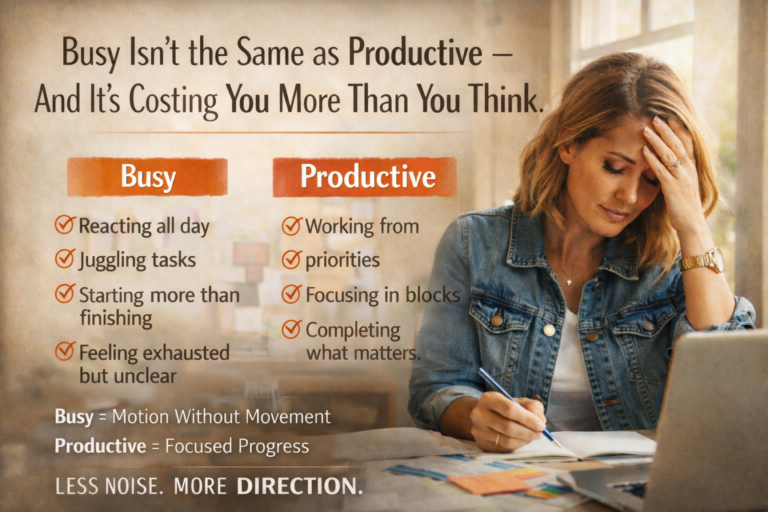
But visible effort is not the same thing as meaningful progress.
There is a quiet difference between building something and reacting to everything. That difference is direction.
Hustle culture appeals because it offers a sense of control. If something isn’t working, you can always do more. More effort feels responsible. It feels committed. It feels like you’re taking ownership of your results. Yet without direction, additional effort often magnifies the very problems you are trying to solve. You become busier without becoming clearer. You produce more without refining what matters. You expand before stabilizing.
Direction forces a different question. Instead of asking, “What else can I do?” it asks, “What am I actually building?”
That question changes everything.
When a woman operates without direction, she tends to mistake activity for alignment. She redesigns her website again. She experiments with another offer. She pivots her messaging for the third time this year. She signs up for another program, hoping this one will unlock the missing piece. Each decision seems reasonable in isolation. But taken together, they form a pattern of reaction rather than intention.
The problem is not a lack of intelligence. It is rarely a lack of discipline. More often, it is the absence of a clearly defined path. Without a defined path, every opportunity feels equally important. Every distraction feels justified. Every new idea competes for attention.
Direction simplifies.
When you know who you are building for, what stage your business is in, and what your core objective is for this season, decisions narrow naturally. You begin to measure opportunities against a framework rather than your emotions. You stop chasing visibility for its own sake and start asking whether that visibility serves a larger structure. You become less interested in appearing productive and more interested in being strategic.
This is where many women feel resistance. Hustle is socially rewarded. Direction is not always obvious from the outside. Hustle produces visible signals: posts, launches, collaborations, announcements. Direction produces internal clarity first. It looks slower. It often looks quieter. In its early stages, it may even look like you are doing less.
But doing less can be a sign of maturity.
A business that relies on constant urgency will always feel fragile. It depends on your energy being high, your motivation being steady, and your presence being constant. Direction, on the other hand, builds systems. It clarifies positioning. It defines offers with precision. It establishes priorities. Systems reduce noise. Precision reduces wasted effort. Priorities protect your time.
Over time, this difference compounds.
Hustle tends to create cycles. You push hard, burn out, regroup, and push again. Direction creates momentum. You build foundations that support the next layer. Instead of rebuilding repeatedly, you refine. Instead of expanding randomly, you strengthen what already exists.
There is also a psychological shift that comes with direction. When you are hustling, your self-worth can become attached to output. If you are not producing, you feel behind. If you are not visible, you feel irrelevant. Direction separates identity from constant performance. It reminds you that progress is not measured by how exhausted you are at the end of the day. It is measured by how aligned your actions are with your long-term objective.
This is particularly important for women who are capable and ambitious but also thoughtful. Many of them are not afraid of hard work. What they are tired of is fragmentation. They have ideas. They have skills. They have experience. What they lack is an integrated structure that connects those pieces in a way that makes sense.
Direction provides that structure.
It requires honest evaluation. It requires acknowledging what is working and what is simply consuming time. It requires defining what success looks like for you instead of borrowing someone else’s template. It requires boundaries around what does not fit your focus, even if it appears attractive in the moment.
None of this is glamorous. It does not create instant applause. It does not guarantee overnight growth. But it builds resilience. It builds clarity. It builds authority slowly and steadily.
The irony is that direction often reduces effort in the long run. When your messaging is clear, you do not constantly rewrite it. When your offers are defined, you do not reinvent them monthly. When your systems are established, you do not rely on last-minute urgency to generate results. What once required frantic motion becomes a series of deliberate, repeatable actions.
That is what sustainable growth looks like.
Hustle tells you that speed is the answer. Direction asks whether you are headed somewhere meaningful. Hustle thrives on adrenaline. Direction thrives on intention. Hustle reacts to pressure. Direction anticipates it.
If you have been working hard but still feel scattered, the solution is not necessarily to increase your effort. It may be to pause long enough to define your path. Clarity can feel uncomfortable at first because it eliminates excuses. Once you choose a direction, you can no longer blame confusion for inconsistent results. But clarity also creates freedom. It removes unnecessary decisions. It protects your energy. It allows you to move forward with confidence instead of constant recalibration.
Bossing up, in its most mature form, is not about proving how much you can endure. It is about choosing where your effort belongs. It is about building with intention rather than reacting with intensity. It is about understanding that authority is not built by volume alone, but by alignment over time.
Direction does not make you slower. It makes you deliberate.
And deliberate action, repeated consistently, will always outperform scattered hustle in the long run.
Start small. Start focused.
Explore the Boss Up Club reset tools, resources, and community — and take the next step that actually matters.