
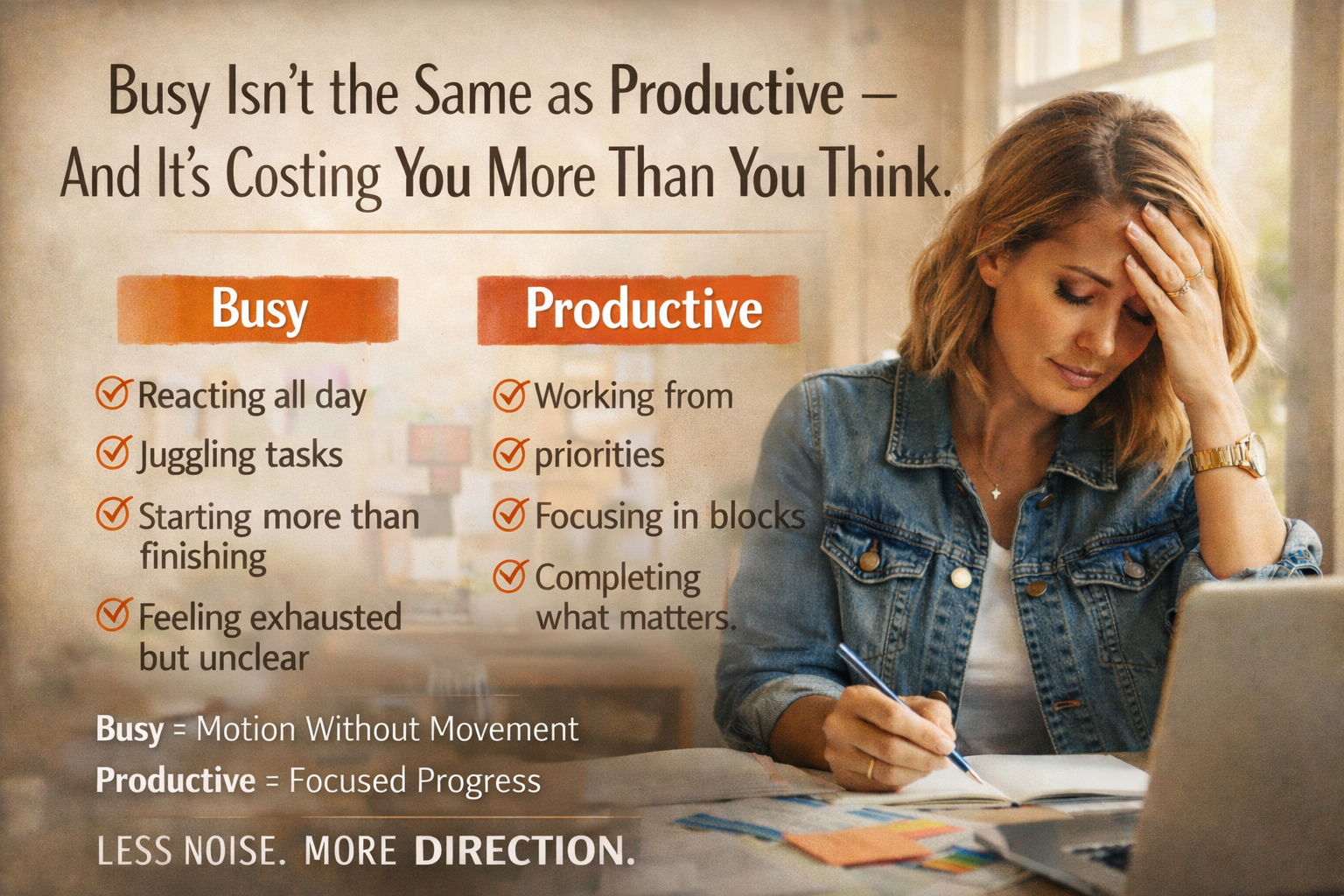
Busy Isn’t the Same as Productive — And It’s Costing You More Than You Think
There is a particular kind of comfort in being busy. A full calendar creates the illusion of progress. Notifications, meetings, tasks, messages, drafts, updates — they fill the day with visible effort. At the end of it, you can point to what you did and say, “I worked hard.”
But productivity is not measured by effort alone. It is measured by movement toward a defined outcome.
Busyness feels responsible. It feels disciplined. It feels like commitment. Yet in many businesses — especially online businesses — busyness quietly replaces clarity. Instead of advancing a strategy, you maintain activity. Instead of building assets, you manage motion.
The difference is subtle at first.
A busy day might include responding to emails, updating graphics, rewriting copy, brainstorming new ideas, watching webinars, tweaking pricing, answering messages, and planning future content. None of these tasks are inherently wrong. In fact, many are necessary at certain stages.
The problem arises when none of them are tied to a larger objective.
Without a defined priority, everything feels equally important. When everything feels important, you default to whatever is most immediate. The loudest notification wins. The most recent idea wins. The smallest discomfort demands attention.
That is how entire weeks pass without meaningful progress.
Productivity requires a hierarchy. It requires deciding which actions directly move the business forward and which actions simply maintain activity. Not all effort produces growth. Some effort preserves comfort. Some effort avoids harder decisions. Some effort delays the deeper work of defining what you truly want to build.
Being busy often protects you from confronting uncertainty. It is easier to complete small, familiar tasks than to step back and evaluate whether your overall direction makes sense. It is easier to respond than to refine. It is easier to adjust details than to examine structure.
Yet the cost of this avoidance compounds.
When you operate in a constant state of busyness, you expend energy without strengthening foundations. You produce output without improving positioning. You create content without clarifying messaging. You launch offers without strengthening systems. Over time, this creates frustration. You feel as though you are working continuously, yet the results remain inconsistent.
The hidden cost of busyness is not only time. It is opportunity.
Every hour spent reacting is an hour not spent building something durable. Every scattered day delays momentum. Every misaligned task consumes attention that could have been invested in refinement, simplification, or strategic expansion.
Productivity, in contrast, often looks slower on the surface. It may involve fewer visible tasks. It may involve saying no to opportunities that would create short-term excitement. It may involve stepping away from constant posting in order to strengthen an offer behind the scenes.
But productive work compounds.
When you invest time clarifying your positioning, future marketing becomes easier. When you build a clear offer structure, sales conversations become simpler. When you create systems for onboarding or delivery, you reduce future friction. Each productive action strengthens the next.
Busyness rarely compounds. It exhausts.
There is also a psychological distinction between the two states. Busyness keeps you in reaction mode. Your attention remains fragmented. You are constantly switching contexts. You measure your day by how much you completed rather than by whether what you completed mattered.
Productivity demands focus. It asks you to tolerate discomfort long enough to finish meaningful work. It asks you to delay small satisfactions in favor of larger progress. It asks you to define what success looks like this month, not just this afternoon.
This shift can feel uncomfortable. When you remove unnecessary tasks, you create space. That space can initially feel empty. Without constant motion, you may feel as though you are not doing enough. This is where many women unconsciously return to busyness. The quiet feels unfamiliar.
Yet clarity often emerges in that quiet.
If you examine your week honestly, you may notice patterns. Certain tasks repeatedly consume time without strengthening results. Certain projects remain perpetually unfinished because they require deeper thinking. Certain goals remain vague because defining them would require commitment.
Productive businesses are built on defined priorities. These priorities are not aspirational statements. They are operational. They influence what gets scheduled, what gets delegated, and what gets ignored. They influence how you measure success.
For example, if your current priority is refining your core offer, then activities that do not support that refinement become secondary. If your focus is strengthening lead generation, then tasks unrelated to audience growth move down the list. This does not eliminate busyness entirely, but it organizes it.
The moment you define what matters most, decisions simplify.
Another important distinction is revenue alignment. Busy tasks often feel productive because they are visible. But visible work is not always revenue-generating work. Updating a logo may feel satisfying, but it may not increase sales. Perfecting a new template may feel useful, but it may not attract qualified leads.
Productivity asks a harder question: does this activity directly support income, authority, or long-term growth?
If the answer is no, it may still be worth doing — but it should not dominate your schedule.
There is also the matter of energy. Busyness drains. Productivity channels. When your work is aligned with a defined objective, you experience less internal resistance. You are not fighting yourself. You are not second-guessing constantly. You are not pivoting midstream.
Over time, this steadiness becomes visible in your results. Your messaging sharpens. Your offers stabilize. Your confidence strengthens because it is rooted in structure rather than adrenaline.
Being busy is not a character flaw. It is often a transitional state. Many women enter entrepreneurship with enthusiasm and a willingness to try. That willingness is valuable. But at some point, experimentation must give way to refinement.
The shift from busy to productive is a shift from reacting to leading.
It requires asking different questions. Instead of “What can I do today?” you ask, “What moves this forward?” Instead of “What should I add?” you ask, “What should I remove?” Instead of “How do I stay visible?” you ask, “How do I strengthen what I’m building?”
These questions create focus.
And focus creates leverage.
If you feel constantly occupied yet unsatisfied with your progress, the solution is not necessarily more effort. It may be fewer, more deliberate decisions. It may be narrowing your attention. It may be redefining your metrics for success.
Productivity is not about intensity. It is about intention.
Once that shift is made, your calendar may look lighter. Your to-do list may shrink. But your results will begin to reflect alignment rather than motion.
And alignment, over time, is what transforms activity into progress.
Before adding anything new, pause and ask:
“Is this moving me forward — or just keeping me busy?”
Inside Boss Up Club, we focus on clarity, completion, and momentum — one intentional step at a time.